

 By Global Arena
There is a quiet crisis playing out across Singapore’s small business landscape. Business owners invest thousands of dollars in beautiful websites, professional photography, and social media marketing. They list themselves on Google Business Profile, collect positive reviews, and even run occasional Google Ads campaigns. Yet when a potential customer searches for exactly what they offer — “best renovation contractor Tampines” or “dental clinic near Bedok” — their website is nowhere to be found on the first page of results.
The business owner assumes the competition is simply bigger or better. But in most cases, the real problem is far more mundane: their website has technical issues that Google can see but they cannot. Issues that take less than an hour to find and fix, but that silently drain traffic and revenue every single day they go unaddressed.
Google Is Not Optional — It Is Your Storefront
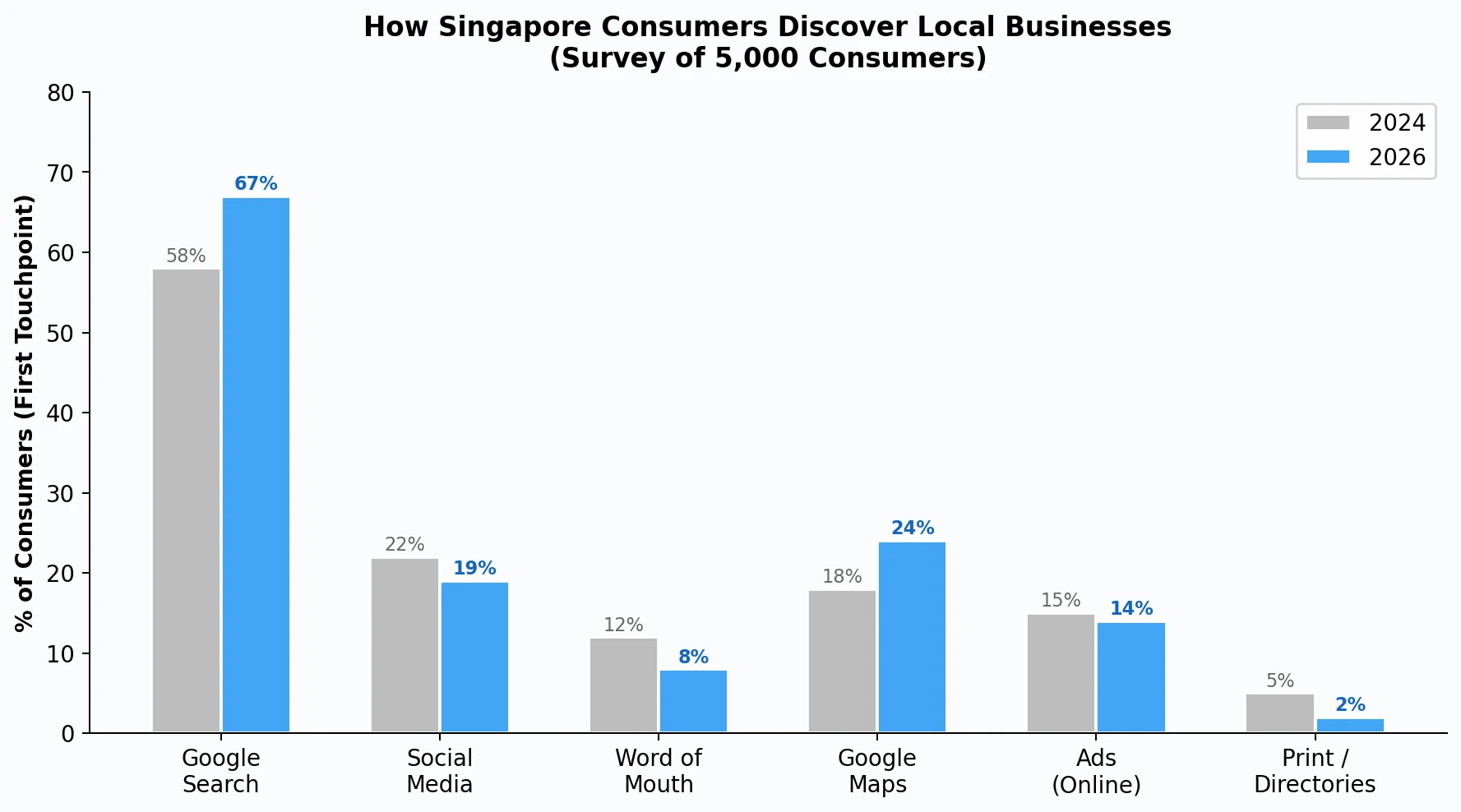
A 2026 survey of 5,000 Singapore consumers found that 67% now discover local businesses through Google Search as their first touchpoint — up from 58% just two years ago. Google Maps accounts for another 24%, and the overlap between the two means that search visibility effectively determines whether most Singapore consumers ever learn your business exists.
Social media, despite the attention it receives, accounts for only 19% of first-discovery interactions and is declining year over year. Word of mouth has dropped from 12% to 8%. Print directories are functionally dead at 2%. The trend is unmistakable: for Singapore businesses, Google is not a marketing channel — it is the marketing channel.
This makes the technical health of your website a business-critical metric, not an IT concern. Every broken link, every missing meta description, every slow-loading page is directly costing you customers who are searching for exactly what you sell and finding your competitors instead.
What Google Sees That You Do Not
When Google’s crawler visits your website, it evaluates hundreds of technical signals that are completely invisible to a human visitor browsing the same pages. A customer who visits your site sees a nice design and reads your content. Google sees:
- Page speed: How quickly each page loads on mobile devices. Google measures this in milliseconds, and the difference between a 1.5-second load time and a 4-second load time can mean a drop of 20+ positions in search results. In Singapore, where mobile internet speeds are among the fastest in the world, users are particularly intolerant of slow sites.
- Meta tag completeness: Whether every page has a unique title tag and meta description. These are the text snippets that appear in search results, and they directly influence whether someone clicks your listing. Missing or duplicate meta tags signal to Google that the site is not well maintained.
- Crawl errors and broken links: Pages that return errors, links that point to deleted content, redirect chains that slow down navigation. Each of these creates friction for Google’s crawler and reduces the percentage of your site that gets properly indexed.
- Structured data: Whether your pages include machine-readable markup that helps Google understand your business type, location, hours, prices, and reviews. Sites with proper structured data are eligible for rich search results — the enhanced listings with star ratings, images, and business details that dominate the top of search results.
- Mobile experience: Whether your site renders properly on mobile devices, whether buttons are large enough to tap, whether text is readable without zooming. Google indexes the mobile version of your site first, so mobile problems affect your rankings even for desktop searches.
Singapore SMEs Are Behind — But the Fix Is Simple
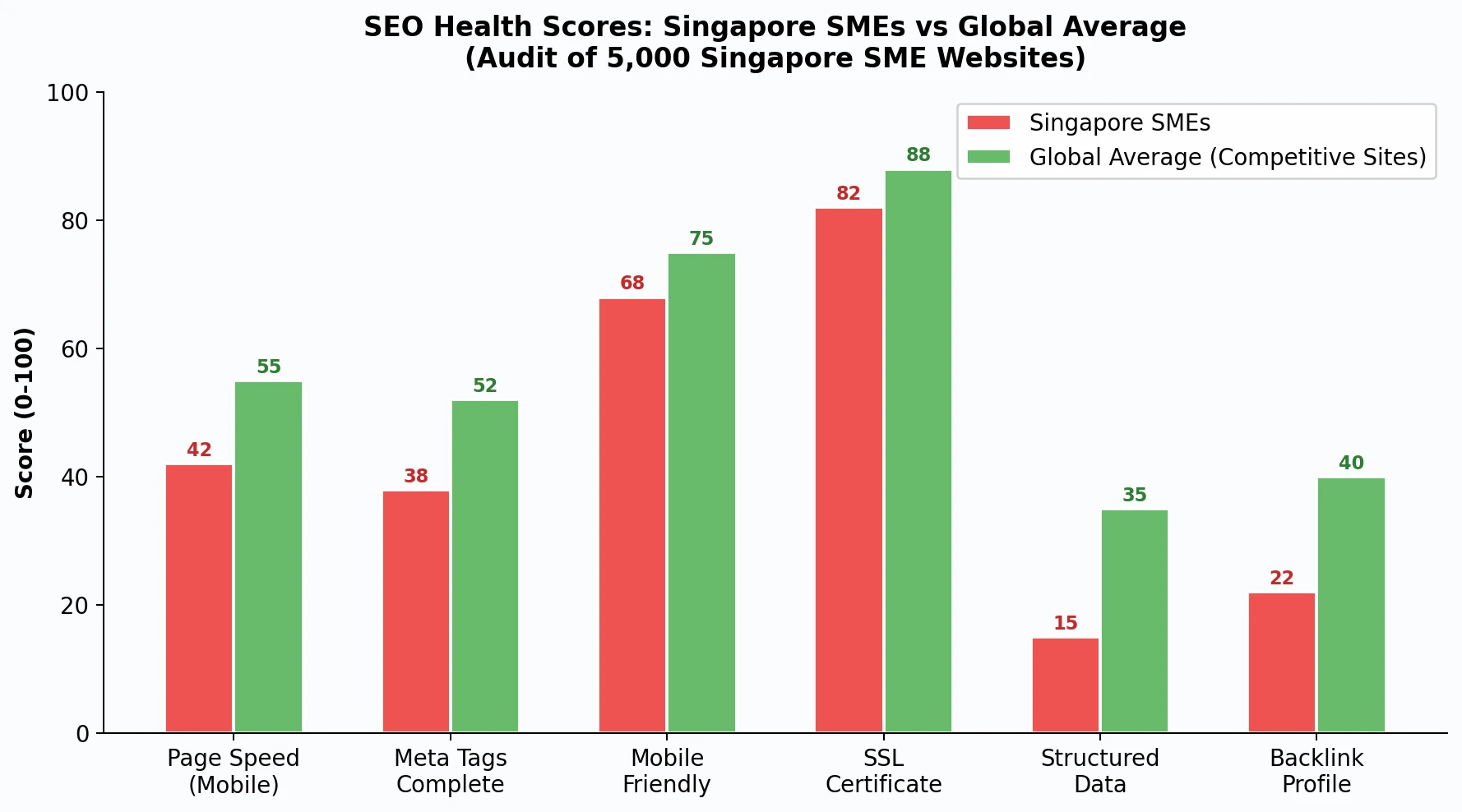
An audit of 5,000 Singapore SME websites revealed scores that should alarm every business owner. Singapore SMEs score an average of 42 out of 100 on mobile page speed — 13 points below the global competitive average. Meta tag completeness scores just 38 out of 100. Structured data implementation sits at a dismal 15 out of 100, compared to a global average of 35.
The only area where Singapore SMEs perform well is SSL certificate adoption at 82% — largely because hosting providers now include SSL by default. Everything else lags significantly behind the sites they are competing against in search results.
The good news is that identifying these issues requires no technical expertise. A free SEO audit tool can scan your entire website in minutes and produce a prioritised report of every issue, ranked by severity and impact. The audit will show you exactly which pages have missing meta descriptions, which images are slowing down your load time, which links are broken, and where your structured data is incomplete.
The 60-Minute Fix That Pays for Itself
For most Singapore SME websites, the highest-impact fixes can be completed in under an hour:
- Fix broken links (10 minutes): Run the audit, identify broken links, and either update them to point to the correct URL or remove them. This has an immediate positive effect on crawl efficiency.
- Write meta descriptions for top pages (15 minutes): Focus on your homepage, service pages, and contact page. Each description should be 150-160 characters, include your location and primary service, and give searchers a clear reason to click.
- Compress images (10 minutes): Upload your largest images to a free compression tool. Most images can be reduced by 60-80% with zero visible quality loss, dramatically improving page speed.
- Add structured data (15 minutes): For a local business, implementing LocalBusiness schema markup tells Google your business name, address, phone number, hours, and service area in a format it can read directly. Free schema generators make this a copy-and-paste task.
- Check mobile rendering (10 minutes): Open your site on a mobile device and tap through every page. Fix any text that is too small, buttons that are too close together, or content that extends beyond the screen edge.
The Compound Return of SEO Health
Unlike paid advertising, which stops generating traffic the moment you stop paying, fixing your website’s technical SEO creates a permanent improvement. A meta description you write today will continue generating clicks for years. An image you compress today will continue loading faster on every future visit. A broken link you fix today will continue allowing Google to crawl pages that were previously invisible.
Singapore businesses that run a comprehensive audit and fix the identified issues typically see organic traffic increases of 40-150% within three to six months — with no ongoing cost. For a business currently getting 1,000 monthly visitors from Google, that improvement translates to 400-1,500 additional potential customers every month, compounding indefinitely.
In a market where 67% of customers find businesses through Google, the question is not whether you can afford to invest an hour in fixing your website’s technical issues. The question is whether you can afford not to.