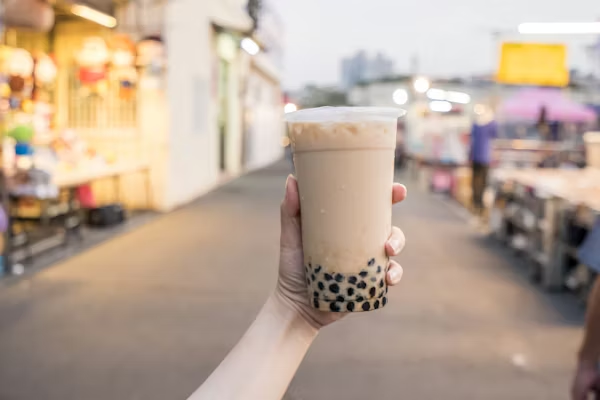
Is bubble tea halal? That’s the first question this guide will answer, and by the end of this full breakdown you will understand exactly what makes bubble tea halal, what doesn’t, how to verify it, and how to confidently order it anywhere.
Bubble tea is one of the world’s most popular drinks right now, yet it raises confusion for many Muslim consumers asking “is bubble tea halal or not?” This comprehensive article leaves no stone unturned: ingredient science, halal certification standards, manufacturing processes, cultural variations, label reading, common myths, regional differences, and practical buying tips.
Understanding the Concept: What “Halal” Really Means
Before we go deeper into whether bubble tea is halal, you must fully understand what halal means in food and drink contexts.
Halal means “permissible” — a food or beverage that is allowed for Muslims to consume according to Islamic law. Halal status is not just about one ingredient — it depends on the entire product, how it was made, where it came from, and how it was handled.
Key principles of halal food and beverage:
• Ingredients must be free from prohibited (haram) material
• Manufacturing processes must avoid contamination with haram sources
• Utensils and equipment used must be clean and free from haram cross‑contact
• Alcohol at any significant level can make a product haram
• Animal‑derived ingredients must come from halal‑slaughtered sources
Bubble tea itself is a mix of tea plus extras. Tea in its simplest form is halal — it’s just leaves and water. But when you add milk, sweeteners, jellies, flavorings, toppings, or even alcohol‑based extracts, it becomes more complicated.
This is why answering is bubble tea halal requires a deeper look.
Why “Is Bubble Tea Halal” Is Not a Simple Yes or No
You might assume “bubble tea must be halal because it’s tea!”
But that doesn’t always hold true. Bubble tea products vary widely around the world — ingredients, brands, suppliers, processes, and certification practices all differ.
Therefore, we must look at:
• Components (milk, tapioca pearls, syrups, toppings)
• Production methods
• Halal certification involvement
• Supplier transparency
• Regional food standards
Let’s break these down clearly.
What Bubble Tea Is Made Of — Full Ingredient Breakdown
To determine whether bubble tea is halal, we must analyze every major ingredient.
Tea Base
Bubble tea uses tea leaves — black, green, oolong, or specialty blends.
Tea leaves are completely halal when plain. There is no inherent alcohol content in brewed tea unless added later.
✔ Tea base on its own is halal
✘ Tea base can become haram if mixed with alcohol or prohibited extracts
Milk & Dairy Alternatives
Most bubble tea uses milk or creamer to create milk tea variants.
Milk options include:
• Cow milk
• Soy milk
• Almond milk
• Oat milk
• Coconut milk
• Non‑dairy creamers
Key halal risk: non‑dairy creamer may contain emulsifiers or gelatin derived from animal sources that are not halal.
Halal rules for milk:
✔ Milk from a halal / permitted animal is halal
✔ Plant‑based milks are halal
✘ Milk additives derived from forbidden sources (e.g., pig gelatin) are haram
Checking whether dairy additives are halal requires label reading or certification verification.
Sweeteners
Bubble tea uses different sweeteners:
• Cane sugar
• Beet sugar
• Fructose
• Honey
• Sucrose
• Syrups
Most sugars are halal, BUT there is one caveat: some sugar processing involves bone char from animals, which can be a concern for strict halal observance.
General sugar guidance:
✔ Unprocessed sugar from plants is halal
✔ Certified halal sugar is recommended
✘ Sugar filtered with non‑halal animal bone char may be controversial for some
Tapioca Pearls / Boba Balls
Tapioca pearls are made from tapioca starch (derived from cassava root). On their own they are halal.
Possible issues can arise if colorants or texturizers are added that are not halal.
✔ Pure tapioca pearls are halal
✘ Pearls with animal‑derived additives without halal certification are doubtful
Flavorings and Extracts
Bubble tea can include:
• Fruit flavorings
• Coffee extracts
• Chocolate
• Vanilla
• Caramel
• Cream flavor
Some flavorings contain alcohol carriers or emulsifiers derived from animal sources.
Common problematic additives:
• Glycerin from non‑halal animal fat
• Alcohol‑based flavor extracts
• Gelatin from non‑halal animals
Whenever flavorings are used, check halal certification.
Jellies, Popping Boba, Puddings, and Toppings
Different shops add extras:
• Fruit jellies
• Grass jelly
• Popping boba
• Egg pudding
• Aloe
• Red bean
Risks:
✘ Jellies made with gelatin from non‑halal animals
✘ Popping boba with non‑halal carriers
✔ Jellies made from agar (plant) are halal
If gelatin is used it must be from halal‑slaughtered animals.
Production & Handling — Critical For Halal Status
Even with halal ingredients, contamination can break halal assurance.
Key areas to consider:
Equipment Sharing
If equipment used for bubble tea is also used for alcohol drinks, pork products, or non‑halal items, cross‑contamination can occur.
Example:
A blender used for bubble tea and non‑halal shakes may transfer traces of the non‑halal product.
Cross Contamination
Utensils, spoons, straws, cups, and surfaces must be handled with halal safety in mind.
Strict halal requirements include:
• Separate utensils for halal and non‑halal
• Proper cleaning protocols
• Training of staff in halal handling procedures
Halal Certification — The Strongest Verification
The most reliable proof that bubble tea is halal is certification by a recognized halal authority.
Major certification bodies include:
• JAKIM (Malaysia)
• MUIS (Singapore)
• IFANCA (International)
• Halal Certification Authority (UAE)
• Various national halal certification boards
Certified products will display a halal logo and ID number.
Common Halal Logos and How to Verify Them
Halal logos look different by region. A logo by itself doesn’t automatically guarantee product integrity — verification is key.
Steps to verify:
- Check the certification code printed on the package
- Visit the certification body’s website
- Search the product or company name
- Confirm the certification expiration date
This step is crucial when you ask “is bubble tea halal” because many suppliers may display halal claims without verification.
Common Misconceptions About Bubble Tea and Halal Status
❌ “All bubble tea is automatically halal because it’s just tea.”
False — many added ingredients can change status.
❌ “If it has no alcohol listed, it must be halal.”
False — alcohol‑based flavors can be used in very small amounts and not listed prominently.
❌ “If no meat ingredients are there, it is halal.”
Not true — halal rules cover more than meat. Additives, processing, equipment, and handling all matter.
Regional Differences — Bubble Tea Halal Practices Around the World
Malaysia and Indonesia
Strict halal certification enforcement. Many brands are certified and regulated, so the question is bubble tea halal often has a clearer answer.
Singapore
Many bubble tea shops voluntarily get halal certification to serve Muslim customers. Certification logos are common.
United States & Europe
No universal halal requirement unless served for Muslim customers. Some shops may label halal, others may not.
Middle East
Mostly halal certification enforcement is strong, but imported flavorings may still need verification.
Checklist: How To Know if Bubble Tea Is Halal in Any Shop
Use this practical checklist before ordering:
✔ Ask if ingredients are halal certified
✔ Check for halal logo on ingredient containers
✔ Confirm there is no alcohol in flavorings
✔ Ask if pearls/jellies contain gelatin
✔ Ask if equipment is shared with non‑halal items
✔ Verify certification code online if possible
When you systematically check, you can confidently answer is bubble tea halal in any situation.
How to Read Bubble Tea Labels for Halal Assurance
When buying packaged bubble tea products or syrups:
Label Reading Tips
• Check ingredient list for alcohol, gelatin, glycerin
• Look for halal certification logo
• Identify the halal certifying body
• Check the expiry and certification code
• Avoid ambiguous terms like “natural flavors” without explanation
Common Ingredients That Can Make Bubble Tea Not Halal
Here are specific problematic substances:
Gelatin from Non‑Halal Sources
Often used in jellies toppings.
Alcohol Used as Flavor Carrier
Small amounts can make the drink non‑halal.
Lard‑Derived Emulsifiers
Hidden sources used in some toppings.
Non‑Halal Glycerin
Glycerin can be sourced from animals — not always halal.
Safe Ingredients That Ensure a Bubble Tea Is Halal
These are generally halal:
✔ Tea base
✔ Plant‑based milks
✔ Sugar
✔ Tapioca pearls
✔ Agar‑based jellies
✔ Certified halal syrups
An expert understanding of ingredient sourcing helps decide whether bubble tea is halal in practice.
Tips for Muslim Bubble Tea Lovers
☑ Choose shops with halal certification
☑ Ask staff about ingredients
☑ Request no toppings if unsure
☑ Bring a flavor list and check syrup sources
☑ Use only shops that train staff in halal handling
By following these steps, you gain confidence in your choice and answer “is bubble tea halal” with certainty.
Frequently Asked Questions (FAQs)
Q: Can bubble tea ever be haram?
Yes — if it contains alcohol, non‑halal gelatin, or ingredients from forbidden sources.
Q: Does tapioca make bubble tea haram?
No — tapioca pearls are halal by themselves.
Q: Is milk tea halal?
It can be, but only if the milk and additives come from halal sources.
Q: Are popping boba toppings halal?
They can be if made with plant‑based ingredients.
Q: Can halal certified bubble tea still be unsafe?
Only if certification is outdated or misused.
Summary: Can You Answer “Is Bubble Tea Halal”?
Yes — but only when all:
✔ Ingredients are halal
✔ Processes avoid contamination
✔ Certification is verified
✔ Handling is done with halal standards
If any are missing, the drink may not be halal.
Your confidence comes from systematic checking and certification verification.
Conclusion: The Truth About “Is Bubble Tea Halal”
Bubble tea is not automatically halal — but you CAN ensure it is halal by knowing ingredients, certification, and handling. When you ask “is bubble tea halal,” you must think beyond tea itself and dig into additives, processes, and vendor practices.
Once you do this, you not only know the answer — you own it.