

 By Global Arena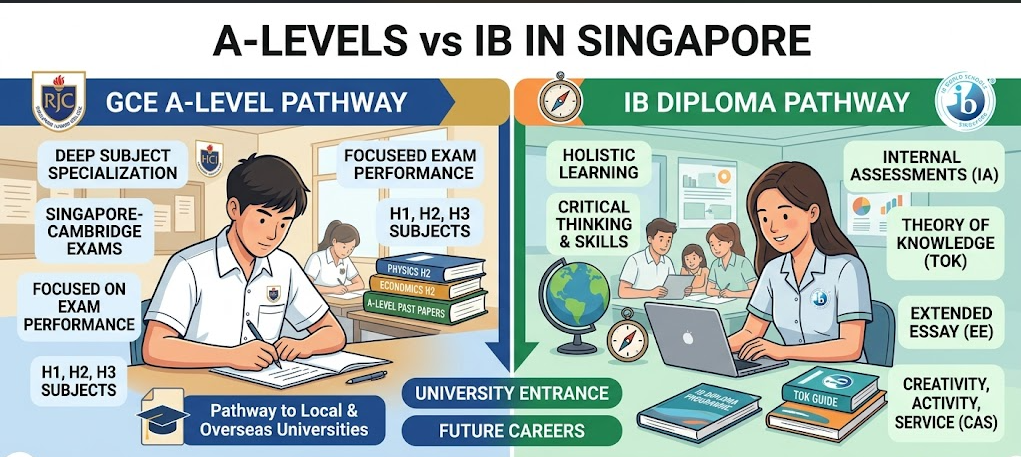
Choosing the best learning pathway for a child is one of the most important decisions families have to make. For students planning to pursue international education, the choice often narrows down between A-Levels and the International Baccalaureate (IB) Diploma Programme. Both are popular programmes offered by many international schools and are designed to help students get into the best universities, both in Singapore and overseas.
When selecting between these programmes, it is helpful to consider which one best aligns with your child’s own learning style and aspirations while supporting their readiness for the future. Both qualifications are highly respected, but they differ in their academic structure, assessment methods, and overall learning approach. In this article, we will look at A Level vs IB in Singapore, comparing each programme’s focus and approach, so you can make a more informed decision about which educational pathway may be the right fit for your child.
Understanding A-Levels and the IB
A-Levels and the IB Diploma Programme are both two-year pre-university qualifications commonly offered by international schools in Singapore. Both are recognised by universities around the world and provide students with pathways to higher education in both Singapore and abroad.
While these programmes share the same goal of preparing students for university, they each take different approaches. A-Levels place greater emphasis on subject specialisation, while the IB encourages students to maintain a broader academic profile. Understanding this distinction is often the first step in determining which pathway may suit your child better.
Curriculum Structure and Subject Focus
One of the key differences between A-Levels and the IB is the number of subjects students study under each programme. A-Level students typically focus on three or four subjects over two years, allowing them to develop deeper knowledge in areas that align with their strengths or intended focus during university study. This can be particularly beneficial for students who already have a clear academic direction.
The IB, on the other hand, takes a broader, interconnected approach. Under this programme, students are required to study six subjects across different subject groups while also completing core components such as the Extended Essay, Theory of Knowledge, and Creativity, Activity, Service (CAS). This structure may appeal to students who enjoy exploring a wider range of disciplines and prefer to keep their future options open for longer.
How Students Are Assessed
Assessment style is another important area for families to look into. A-Levels are largely examination-based, with final grades determined mainly through external examinations taken at the end of the programme. This assessment approach may be more suitable for students who perform well under exam conditions and prefer a clear assessment structure.
Under the IB, final examinations are combined with coursework and internal assessments completed throughout the programme. Students may be required to complete essays, presentations, practical work, and research assignments. This means that performance is evaluated across different forms of assessment rather than relying solely on end-of-course examinations. Students who demonstrate their abilities in different ways may find this assessment system advantageous.
Independent Learning and Academic Skills
While both A-Levels and the IB help students prepare for university, each pathway develops academic skills in different ways. A-Levels encourage students to build strong subject expertise through intensive study. This focus and depth of learning can be useful for students pursuing specialised university courses such as engineering, medicine, or law.
Meanwhile, the IB places additional emphasis on independent research, critical thinking, and academic inquiry. Programme components such as the Extended Essay require students to undertake substantial independent work, while Theory of Knowledge encourages a critical evaluation of how knowledge is developed across different disciplines. These experiences can help students become more confident researchers and independent learners before entering university.
Workload and Study Demands
The workload associated with each programme can feel quite different. While A-Level students generally focus their attention on a smaller number of subjects, the depth of content they are required to master can be demanding. Academic pressure often increases as final examinations approach, making strong revision habits particularly important.
IB students are mainly required to balance six subjects alongside coursework and core programme requirements. As a result, the workload tends to be spread more evenly throughout the two years. Under the programme, students are often expected to manage multiple deadlines at the same time. That said, children who are organised and comfortable handling ongoing assignments may adapt well to the IB environment, while others may prefer the more focused structure of A-Levels.
When choosing between A-Levels and the IB programme, there really is no single “best” answer. Both pathways offer distinct advantages in helping prepare your child for university while opening opportunities for students to develop the skills and confidence to face the future with curiosity and purpose. Ultimately, the decision depends on your child’s own learning style, personal preferences, strengths, and long-term aspirations.
 Prime Star