
 By Global Arena
Have you ever wondered why ITIL® keeps evolving and what actually makes the latest version different? If you have worked in IT Service Management, you might have noticed a clear shift in how organisations operate today. That is why the discussion around ITIL® 5 vs Previous Versions and earlier versions is becoming more relevant.
It is not just an update but a change in approach. By the end of this blog, you will have explored ITIL® Version 5 Foundation Bridge Training. You will also understand how the ITIL® Version 5 Certification Pathway supports your career growth.
What ITIL® 5 is All About
ITIL® 5 is the next stage in how businesses handle IT services in a world that changes quickly. It places ITSM at the centre, focusing on delivering consistent, efficient, and value-driven IT services that truly support business needs. It goes beyond traditional, process-heavy methods and focuses on giving both organisations and customers real value. It does not follow strict rules. Instead, it allows teams to work based on their needs. It also supports modern ways of working like Agile and automation while strengthening ITSM to be more flexible, responsive, and aligned with real-world demands
Key focus areas of ITIL® 5
- Value-driven approach
- Flexible working methods
- Support for modern technologies
- Improved customer experience
- Alignment with business goals
- A quick look at the previous ITIL® version
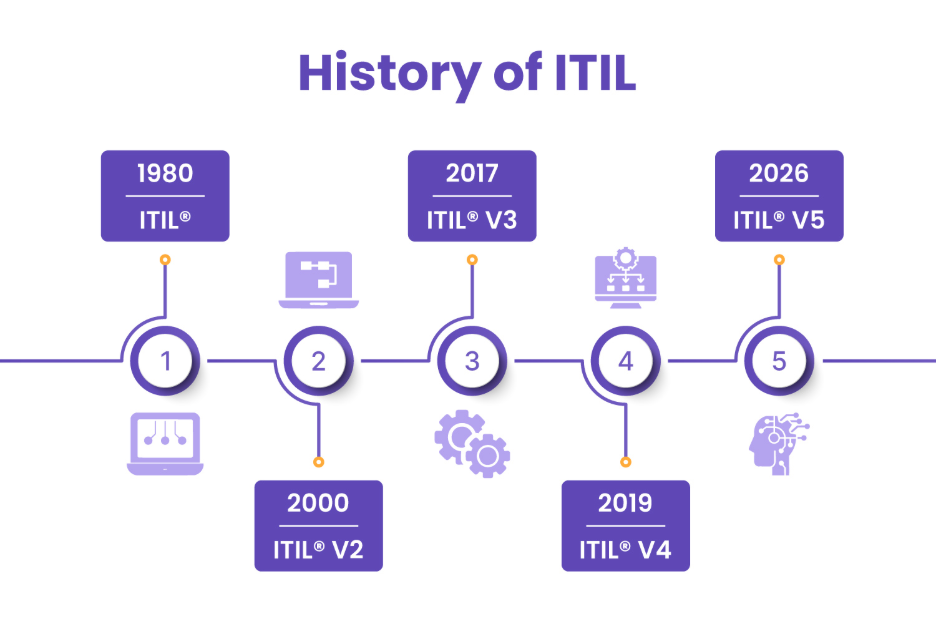
A Quick Look at Previous ITIL® Versions
ITIL® 4 introduced a more flexible and modern approach compared to ITIL® v3. It moved away from strict lifecycles and focused on value creation. It also introduced the Service Value System and management practices.
ITIL® v3 focused more on structured processes and lifecycle stages. It helped organisations standardise IT services but was less flexible for modern needs.
What has Changed in ITIL® 5?
Let’s explore the key improvements that make ITIL® 5 more practical, flexible and aligned with modern business needs:
Shift From Processes to Value
One big distinction between ITIL® 5 and earlier versions is its focus on value. The aim is to deliver outcomes, not just follow steps.
Increased Flexibility for Teams
ITIL® 5 allows teams to adapt their working methods. This makes it easier to work in dynamic and agile environments.
Better Integration with Agile and DevOps
ITIL® 5 works smoothly with Agile and DevOps practices. This allows organisations to combine different approaches without conflict.
Stronger Focus on Customer Experience
Customer expectations are higher now. ITIL® 5 focuses more on user satisfaction than earlier versions.
Improved Support for Modern Technologies
The framework aligns well with cloud, AI and automation. This makes ITIL® 5 more relevant today.
Continuous Improvement Made Simpler
ITIL® 5 encourages teams to improve services regularly in a simple and practical way.
Updated Learning and Certification Options
The ITIL® Version 5 Foundation Bridge Training enables professionals to switch from prior versions without having to start again. It expands on what you already know.
Clearer Career Progression
The new structure is meant to be easier to understand and more concentrated. There are three main streams, and they all start with a required Foundation level:
Streamlined Certification Scheme
The new structure is simpler and more focused. It is divided into key streams, all starting with a Foundation level:
- ITIL® Product: Focuses on developing and managing IT products effectively.
- ITIL® Service: Focuses on delivering and improving IT services.
- ITIL® Experience: Focuses on enhancing user and customer experience.
- ITIL® Strategy: Provides a broader business view and aligns IT with organisational goals.
All these streams are connected through a Foundation entry point, ensuring a strong base for every professional working in ITSM.
Comparison: ITIL® 5 vs Previous Versions
| Feature | ITIL® v3 | ITIL® 4 | ITIL® (Version 5) |
| Core Focus | Service Lifecycle | Service Value System (SVS) | Digital Product & Service Management |
| Main Scope | IT Infrastructure | IT Service Management | Enterprise-wide Digital Value |
| Lifecycle Model | 5 Stages | 6 Value Chain Activities | 8 Lifecycle Activities |
| Unit of Work | Processes | 34 Management Practices | Streamlined Practice Groups |
| Technology | Supportive/Reactive | Digital Transformation | AI-Native / Complexity-Ready |
Conclusion
Understanding ITIL® 5 vs Previous Versions and earlier versions helps you stay updated in IT service management. ITIL® 5 brings flexibility, value focus and better alignment with modern needs. Adapting to these changes is important for professionals who want to stay relevant and confident in their roles.
That is why many choose ITIL® Version 5 Foundation Bridge Training, a trusted global training provider, The Knowledge Academy, to build strong skills and move forward in their ITIL® journey.